

Vision
To be the leading mining company in Indonesia by creating added value for customers and stakeholders.
A concise, evidence-based account of how PT Golden Energy Mines Tbk (GEMS) creates lasting value — for shareholders, communities and the planet — while responsibly managing coal as a transitional energy source.
Winner · Indonesia Sustainability Innovation of the Year — Metals & Mining

Runner-up · Low Carbon Transport Category, Enlit Asia 2025

Platinum Rank · ASRRAT 2024 Sustainability Reporting
Snapshot
Reporting period 1 January – 31 December 2025. Prepared in reference to GRI Standards 2021 and GRI 12 (Coal Sector), externally assured by PT Sucofindo.
Who We Are
PT Golden Energy Mines Tbk (GEMS) is a publicly listed coal mining company founded in 1997 and listed on the Indonesia Stock Exchange since 2011. GEMS mines, transports and trades thermal coal across a range of calorific values, supplying domestic power generation and international energy markets while positioning itself as one of Indonesia's leading, most responsibly-run coal producers.
To be the leading mining company in Indonesia by creating added value for customers and stakeholders.
Scale & footprint
Coal reserves across 66,204 ha
+17,501 contractor workers (64% local)
BIB · KIM · TKS · EMS Group · BSL
99.96% of procurement spend is local
Including China (52%) & India (6%)
vs 25% minimum requirement (18.90 Mt)
Ownership
Founded as PT Bumi Kencana Eka Sakti
Acquired PT Borneo Indobara (BIB), our flagship South Kalimantan concession
Renamed Golden Energy Mines Tbk; listed on the Indonesia Stock Exchange
Majority stake transferred to Golden Energy and Resources Ltd, Singapore
Expanded into Sumatra (EMS Group) and acquired PT Barasentosa Lestari
PT Dian Swastatika Sentosa Tbk becomes majority shareholder (51%)
Record production of 54.95 Mt; Carbon Neutral Miner 2031 roadmap advanced
A dedicated Sustainability Division, headed by the Head of Sustainability & General Manager Office (GMO), reports directly to the President Director — coordinating GEMS's full sustainability agenda, reporting quarterly to executive leadership and annually to the Board of Commissioners and Board of Directors. The Board conducts due-diligence and impact-management reviews monthly in joint BOC/BOD sessions, ensuring sustainability oversight sits at the top of the organisation rather than in a peripheral function.
Why Responsible Mining Matters
Coal remains structurally important to global and Indonesian energy security — but that importance carries a direct obligation to manage its impacts honestly and rigorously. This is the “why” behind every KPI in this report.
Share of global primary energy consumption still met by coal (Energy Institute, 2025)
Indonesia's coal reserves — among the world's largest producers & exporters
Non-Tax State Revenue contributed by Indonesia's mineral & coal sector in 2025
“Coal mining activities generally continue to pose significant negative environmental impacts if not consistently controlled. Activities such as land clearing, excavation, blasting, and coal transportation have the potential to cause greenhouse gas emissions, air pollution, water contamination, and disturbances to biodiversity.”— GEMS 2025 Sustainability Report, acknowledging the industry's inherent risk
“We view coal as a transitional energy source that must be managed responsibly. The integration of ESG principles serves as the foundation of the Company's decision-making to ensure business sustainability amid the evolving energy landscape.”— GEMS Board Message, 2025 Sustainability Report
A four-step process — understanding sustainability context, identifying actual and potential impacts, assessing their significance, and prioritising material topics — anchors every strategic decision. In 2025, a Focus Group Discussion held with relevant divisions, subject-matter experts and the National Center for Corporate Reporting confirmed material topics spanning economic performance, anti-corruption, energy, water, biodiversity, emissions, waste, employment, occupational health & safety, human rights and local communities, each mapped to GRI topic-specific standards.
Our Strategy
GEMS's sustainability strategy is built on three material pillars, underpinned by strong governance and shared values, each translated into concrete strategic objectives and tracked against 2030/2040 targets.
Strengthen good corporate governance and a responsible business culture — from Board-level oversight to site-level compliance.
Integrate sustainability best practice into everyday operations through The Golden Way culture of integrity and continuous improvement.
| Focus area | Metric | 2020 base | 2025 actual | 2030 | 2040 |
|---|---|---|---|---|---|
| Climate Change | Scope 1+2 intensity (tCO2eq/ton) | 0.020 | 0.025* | 0.015 | 0.010 |
| Biodiversity | Shannon-Wiener Index | 0.1 | 3.56 | >3.0 | >3.0 |
| Waste Circularity | Hazardous (B3) recycling rate | 93.3% | 92.97% | 90.0% | 90.0% |
| Mine Closure | Cumulative reclaimed area | 18.00% | 20.02% | 91.00% | 91.00% |
| Water Stewardship | Groundwater consumption (BIB) | 2.3% | 2.30% | 2.0% | 1.5% |
| OHS | Fatalities | 1 | 0 | 0 | 0 |
| OHS | LTIFR (BIB) | 0.07 | 0.07 | <0.10 | <0.05 |
| Equality | Female employees | 17.8% | 21.07% | 30.0% | 35.0% |
| Equality | Local workforce | 17.6% | 17.5% | 20.0% | 25.0% |
| Community | Contribution to community prosperity / total costs | 26.0% | 38% | 35.0% | 50.0% (2050) |
| Community | Human Development Index, Ring 1 (BIB) | 67.66 | 69.60 | 70.10 | 75.00 |
Carbon Neutral Mining Operation by 2031 — ahead of Indonesia's national Net Zero 2060 pathway. Electrification targets: 25% of mining fleet electric by 2026, rising to ~75% within the following two years; fuel-use reduction of ~58% vs. business-as-usual across the value chain.
Governed under a four-pillar TCFD framework (Governance, Strategy, Risk Management, Metrics & Targets). GEMS transparently discloses that a formal climate transition plan and 2°C-scenario analysis are not yet in place — both are active work areas for 2026–2027, alongside the start of Scope 3 emissions calculation.
* During the reporting year, emissions intensity increased by 7.5% compared to the previous year, primarily driven by the expansion of the emissions calculation scope — specifically the recognition of direct emissions from Land Use, Land-Use Change, and Forestry (LULUCF) in 2025, in alignment with ISO 14064-1 standards.
Value Creation Model
Every GEMS activity — from a coal seam to a community water tap — follows the same value-creation logic: capital is invested, activities are performed responsibly, outputs are produced, and those outputs compound into outcomes and long-term impact for stakeholders and the planet.
Financial capital, 66,204 ha of concessions, 674 employees + 17,501 contractors, community partnerships, technology & infrastructure.
Responsible mining, processing, logistics, decarbonisation programs, community development (CDE), stakeholder engagement.
54.95 Mt coal delivered, USD 2,414M revenue generated, Rp65.8bn in community programs, restored land & treated water.
Household income gains, improved health, stronger institutions, employee capability, biodiversity recovery.
Energy security, self-reliant post-mining communities, national economic contribution, a lower-carbon legacy.
| 2025 | 2024 | 2023 | |
|---|---|---|---|
| Total economic value received | 2,421.81 | 2,716.13 | 2,912.96 |
| Operating cost1 | 1,670.05 | 1,623.68 | 1,686.09 |
| Employee salaries & benefits | 48.30 | 47.19 | 38.90 |
| Non-tax revenue payments2 | 321.52 | 350.74 | 463.70 |
| Other payments (taxes)3 | 110.26 | 199.55 | 182.98 |
| CSR / community development funds4 | 5.73 | 6.07 | 5.33 |
| Dividend payments | 214.08 | 484.26 | 424.31 |
| Interest paid to creditors | 6.17 | 5.77 | 7.21 |
| Total economic value retained5 | 45.70 | (1.13) | 104.43 |
1 All operational expenses excluding employee salaries & benefits, interest to creditors, royalties, taxes, dividends and CSR funds. 2 Royalties, deadrent and non-tax state revenue. 3 Corporate income tax & other permits. 4 Excludes local community involvement cost embedded in the Company's business value chain (USD 91.36 million). 5 2024 value is negative due to payment that year of the 2023 final dividend (USD 85 million).
Flagship Value Creation in Action
Transforming a former mining void into a
living water reservoir
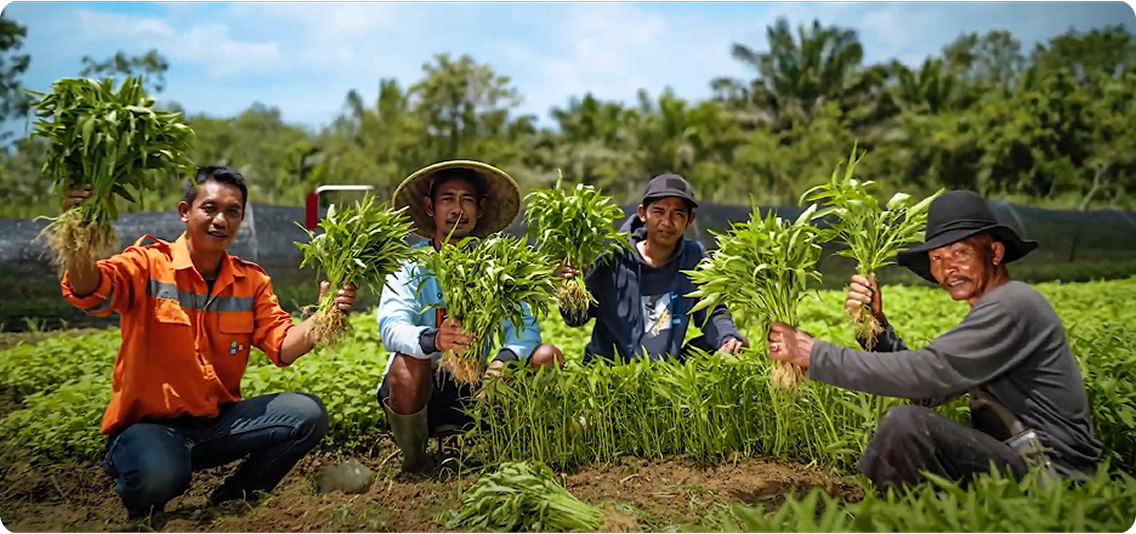
In Angsana District, Tanah Bumbu Regency (South Kalimantan), a coal pit worked out by PT Borneo Indobara (BIB) naturally filled with rain and groundwater after mining ceased. Since 2019, GEMS has invested in transforming that void — “Andaru” — into a community drinking-water source serving Desa Banjarsari and Desa Mekarjaya: not an isolated CSR gesture, but a fully-costed, independently-measured proof point of sustainable post-mining land use.
Foundation phase — core intake, treatment & household connections for underserved villages.
Expansion phase — wider village coverage, reliable supply through the dry season.
Economic phase — WTP & refill stations, bottled water, community-owned enterprises.
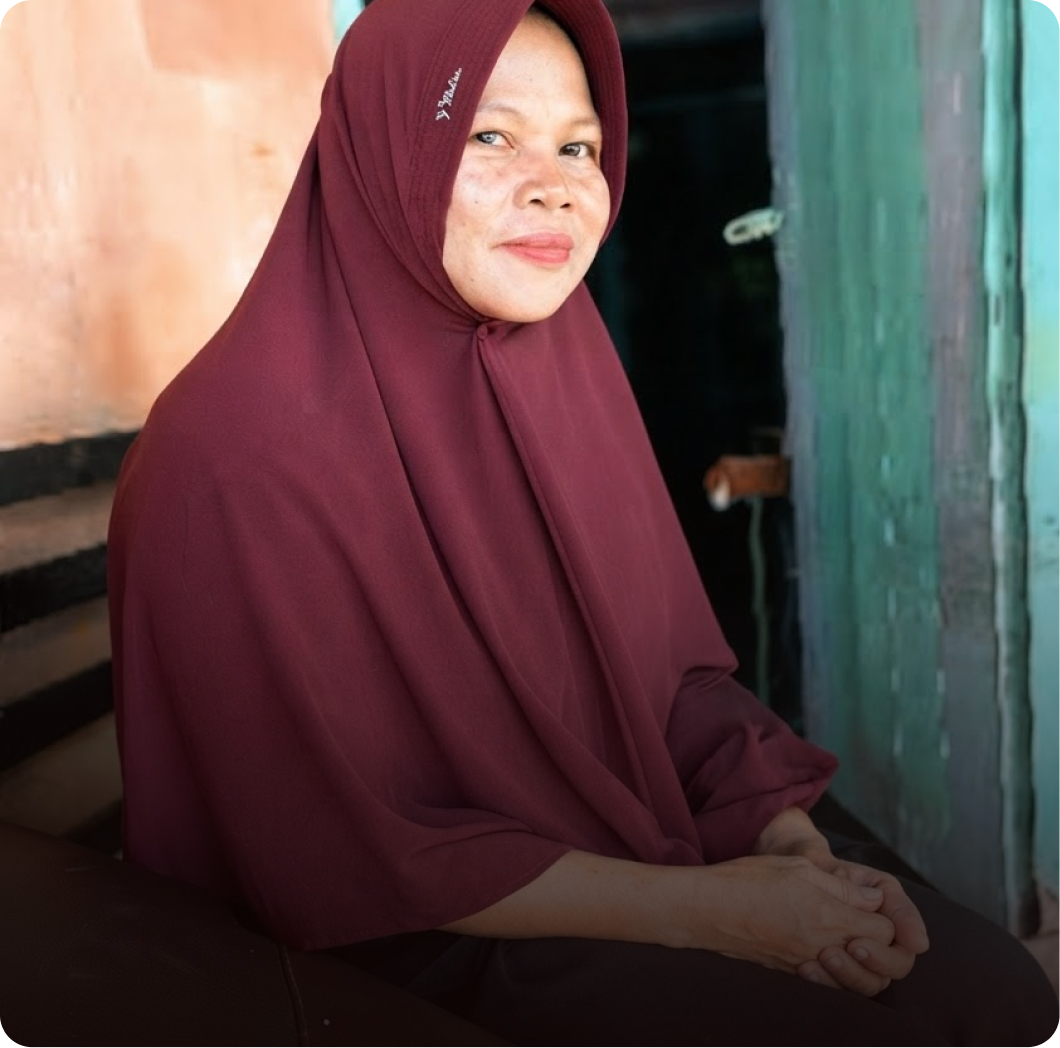
“Thank God, I have my own income now — I can send my children to school and help my husband.”
— Ibu Umi, laundry business owner, Mekarjaya
For every Rp1 the Company invests, it generates Rp5.88 in social and economic value. Social Return on Investment figure is cumulative (2021–2024).
A hazardous, unstable post-mining void — previously a drowning and acid-mine-drainage risk — is now a managed community asset, with 77.9 hectares of surrounding vegetation restored.
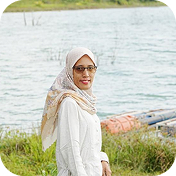
Sundari Puji Rahayu (“Mbak Ayu”)
Treasurer of KP-SPAMS Tirta Wangi, revived the dormant water group and co-authored the village regulation now governing fair water tariffs — earning the community nickname “Wonder Woman of the Pipe Gang.”
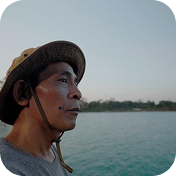
M. Solih
Chair of KP-SPAM Tirta Lumintu Jaya (Mekarjaya), led his group to be named Best KP-SPAM Manager for Kalimantan & Sulawesi (2023) and appeared on national television (Kick Andy) to share the model.
This case is presented as GEMS's flagship proof of sustainable development — not one CSR program among many — because it is the Company's most rigorously, independently measured social investment: quantified through a dedicated SROI study, a Community Satisfaction Index survey, and ongoing third-party (Sucofindo) water-quality assurance.
Our Performance 2025
Total consumption, down from 12,299 TJ (2024)
Emissions intensity, on path to 0.015 (2030)
Vs. 2030 target of 2.0% (BIB)
Hazardous waste recycling rate
“Good–Very Good”; 8,148 ha cumulative restoration
59.16M safe working hours in 2025
Average training per employee (Rp4.8bn budget)
Up from 17.8% baseline (2020)
Rp 65.76 billion allocated across 8 pillars in 2025, reaching 1,114 households (3,342 people). Stunting in Ring-1 villages fell 42% (168 → 98 children).
674 employees and 17,501 contractor workers (BIB). Local Community Development Index: 69.06. LTIFR (BIB): 0.07.
Total Revenue, 2025
Net Income
Non-tax revenue (PNBP) to the State
Anti-corruption communication to all 672 partners
Critical incidents reported to the Board
Stakeholder Responsiveness
Rather than list our communication channels, this chapter demonstrates responsiveness end-to-end: what a stakeholder raised, what GEMS did about it, and the measurable result. This evidence is drawn from an independently-facilitated Stakeholder Engagement / Social License to Operate assessment applying the AA1000 Stakeholder Engagement Standard.
Overall Social License to Operate Index — “High Approval”
Stakeholders mapped, then prioritised as “To Be Engaged” via Power-Interest & AA1000 analysis
External cases (land, environmental, community) formally resolved, 2021–2023
Siltation of the Karuh River; restricted fishing-ground access for coastal communities
River-siltation management under the “100-0-100” universal water-access program; “Kenari Jaya” fisherman empowerment program (Angsana & Bunati)
2,886 household water connections delivered; SROI of 8.23 achieved on the Kenari Jaya program
Local labour absorption; child stunting prevalence; garden and plantation land damage from mud runoff
Dump-truck driver training; Stunting-Free Village collaboration; mud-canal construction
100 people trained across 19 villages; clean-water intervention reached 77 children; food-security program reached 531 children
Local business opportunity in logistics and clean-water shortages in Banjarsari and Mekarjaya
“Kampung Transporter” BUMDes hauling-contractor scheme; Andaru clean-water program; UMKM Center
Grew from 2 to 5 BUMDes across 6 villages; 6,703 household heads benefited; 78% of poor Ring-1 households lifted out of poverty
Fair, transparent access to the Company's logistics and procurement value chain
Open, regulation-compliant tender processes; BUMDes integrated as formal hauling contractors
99.96% of procurement spend (≈USD 1,466M) flows to local suppliers; 672 registered partners
Dust and noise from haul roads, river siltation, and clean-water access
Environmental monitoring, negotiated compensation, mud-canal construction, and Andaru Water Legacy
Noise compensation allocated to village development funds; 1,811 households served with clean and potable water
Need for a credible, formal grievance channel to submit complaints and criticism
Established the BLHI multi-stakeholder forum as a joint grievance and dialogue secretariat
BLHI helped de-escalate a planned protest and resolve a customary land-claim dispute in 2022–2023
Fair labour practice, career development, competency, and a safe working environment
Collective Labour Agreement fulfilment; structured training; Whistleblowing System; OHS facilities
17.29 average training hours per employee; 59.16 million safe working hours with zero fatalities
Transparency on financial condition, accountability, and ESG performance amid a softening coal-price environment
AGMS; Annual & Sustainability Reports assured by PT Sucofindo; active Investor Relations communication
Externally assured disclosures published on schedule; USD 214.1M in dividends paid despite a lower-price cycle
Awards & Recognition
Occupational Health & Safety (45001) and Environmental Management (14001) certifications held Group-wide — the compliance backbone underpinning every award below.
These awards corroborate — rather than substitute for — the performance and stakeholder evidence presented throughout this report, each independently verified by the respective awarding body.
The Road Ahead
25% of mining fleet electric
Technology & CyberSOC & VAPT cybersecurity rollout begins
Climate DisclosureScope 3 emissions calculation starts
~75% mining fleet electrification
GovernanceNIST CSF & ISO 27001 consolidation
Carbon Neutral Mining Operation aspiration
91% cumulative reclamation
Safety<0.05 LTIFR
Social35% female workforce
Net Zero, aligned with Indonesia's national NZE agenda
In the spirit of credible reporting, GEMS discloses openly that a formal climate transition plan and 2°C-or-lower scenario analysis are not yet finalised — both are active priorities for 2026, alongside the first full Scope 3 emissions inventory.
Our Footprint
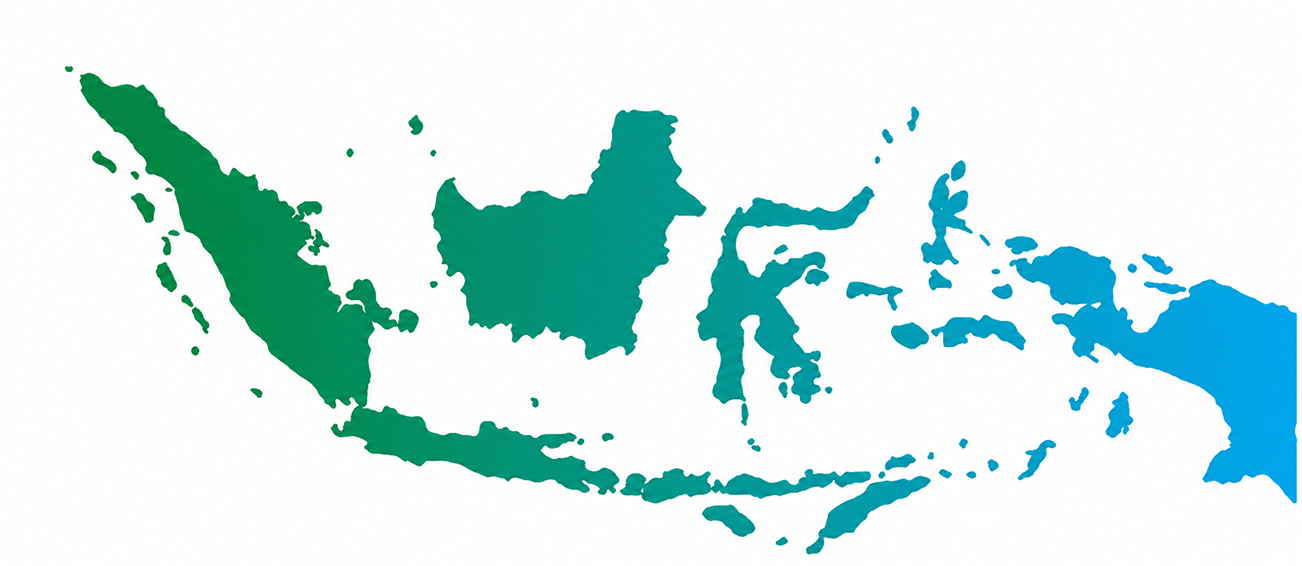
Market footprint (share of volume)
Other Asia-Pacific: Malaysia, Taiwan, the Philippines, Vietnam, South Korea, Cambodia, Singapore, New Zealand & Bangladesh. Bar widths normalised to 100%; source shares are independently rounded.
This document summarises the PT Golden Energy Mines Tbk 2025 Sustainability Report (388 pages), prepared with reference to GRI Standards 2021, GRI 12: Coal Sector, SASB Metals & Mining Standards, and Indonesia's SEOJK 16/SEOJK.04/2021, and externally assured by PT Sucofindo under AA1000AS v3 and ISAE 3000 (Revised). All figures in this Summary are drawn directly from that assured report and its underlying program-level SROI and community satisfaction (IKM/CSI) assessments.

 25–30%
 32Bt
32Bt Rp124.6T